
The End of Passive Giving?
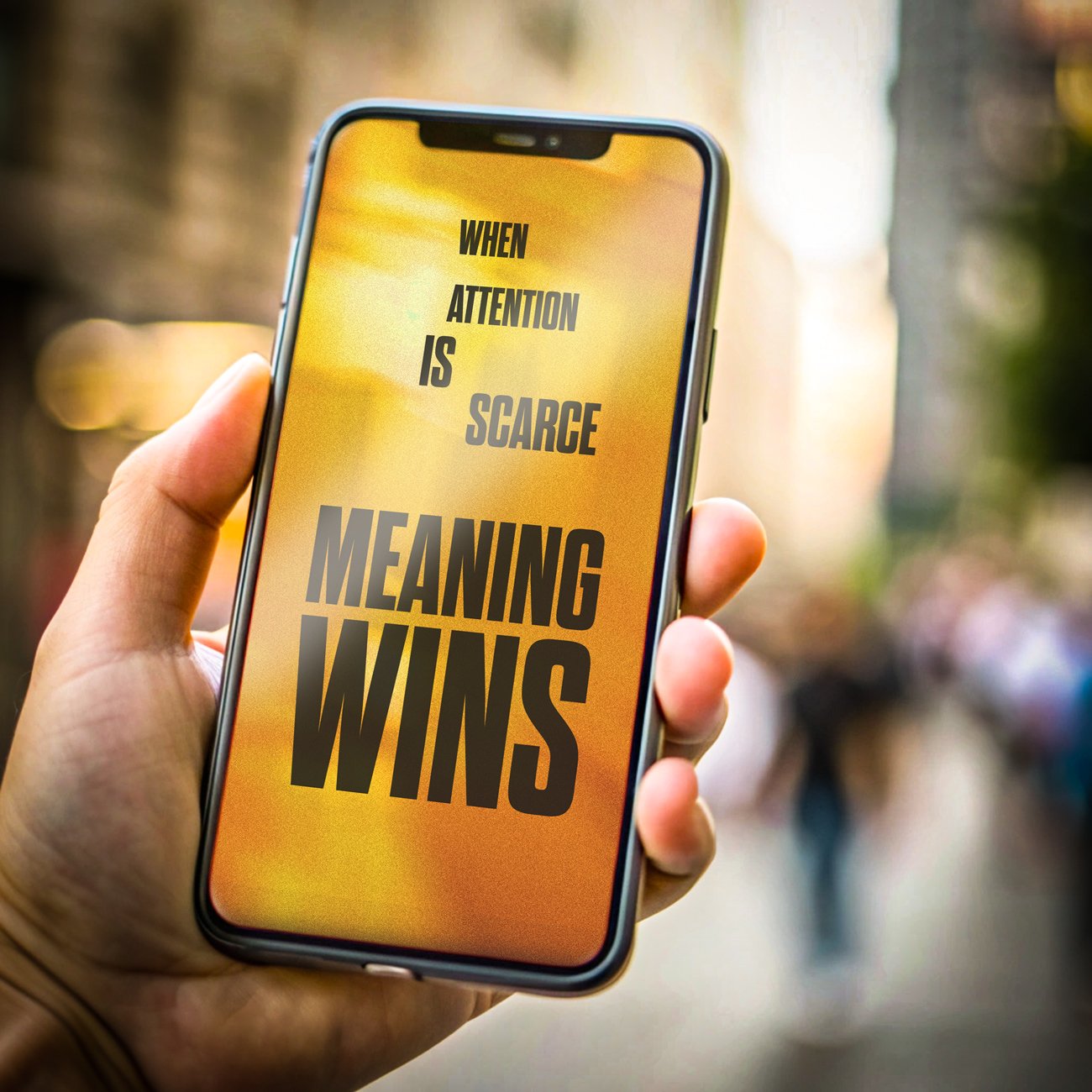
When Attention Is Scarce, Meaning Wins
There’s a quieter shift happening across the charity sector at the moment. It’s not dramatic or headline-grabbing, but it is significant. Fewer people are giving, and those who continue to do so are making more considered decisions about where their money goes. At the same time, the kind of long-term loyalty that many organisations once relied on is becoming increasingly fragile, with supporters far more likely to drift away if something doesn’t resonate.
It’s easy to attribute this entirely to external pressures. The cost of living continues to bite, economic uncertainty hasn’t gone away, and people are understandably more cautious about discretionary spending. But that only tells part of the story. Because while giving may be under pressure, compassion isn’t. People haven’t stopped caring about causes - they’ve simply become more selective about which organisations earn their attention, their trust, and ultimately their support.
The myth of optimisation
For some time now, the sector’s response has been to refine and optimise. Improve the user journey, sharpen the targeting, automate more of the process, and remove friction wherever possible. These are all worthwhile pursuits, and in many cases necessary, but they are built on an assumption that the problem is primarily mechanical - that if the system works more efficiently, the results will follow.
In reality, that’s rarely where the breakdown occurs. Supporters are not disengaging because a form is too long or a button is poorly placed. More often, they disengage because the communication to an increasingly embattled audience fails to move them. In an environment saturated with asks, updates, and competing messages, attention is no longer something that can be expected as a given. It has to be earned, and earning it requires more than process - it requires meaning.
From transactions to meaning
What we are seeing is less a technological shift and more an emotional one. Giving is no longer passive or habitual in the way it once was; it has become a more conscious and considered act. Supporters are asking themselves whether they trust the organisation, whether they understand the impact of their contribution, and whether the communication they are receiving makes them feel anything at all.
If those questions aren’t answered clearly, or if the experience feels generic or interchangeable with countless others, people simply move on. Not out of apathy, but because something else has made a stronger, more immediate connection. In that sense, the competition is no longer just between charities, but between any message capable of capturing attention and creating a sense of relevance.
The attention deficit economy
All of this is happening within what might best be described as an attention deficit economy. The volume of communication people are exposed to on a daily basis is extraordinary, and much of it is designed to prompt an instant reaction. Digital channels, for all their strengths, have intensified this dynamic by making it easier than ever to publish, distribute, and repeat messages at scale.
The unintended consequence is that attention has become both fragmented and fleeting. Messages are seen but not absorbed, acknowledged but not remembered. In that context, simply increasing frequency or visibility does not necessarily lead to greater engagement. In many cases, it achieves the opposite and you lose followers.
Why physical still matters
This is where physical communication, and direct mail in particular, retains a distinct and often underestimated strength. A piece of mail operates to a different rhythm. It doesn’t compete in the same immediate, transient way as digital content, and it isn’t dismissed with a swipe or a scroll. Instead, it arrives as something tangible, something that occupies space and asks, however briefly, for a moment of time.
That shift in dynamic is important. Time implies value, and value creates the conditions for attention to settle rather than pass by. In a sector where trust and attention are increasingly hard-won, that physical presence can carry a weight that digital alone often struggles to achieve. A well-considered piece of direct mail can convey effort, care, and intention in a way that feels inherently more personal, providing the space for a story to unfold without interruption and allowing the reader to engage more deeply and, crucially, to remember. Recently there's been a shift to innovative folds, that literally unfold a story and engage the donor. Subliminally they appreciate the extra consideration you've shown them. They feel valued.
In an environment defined by speed and volume, that sense of pause is increasingly rare, and it is precisely that rarity that gives it impact.
What this means for charities
The organisations navigating this landscape most effectively are not necessarily those doing more, or moving faster, or adopting every new tool available to them. Instead, they are those that communicate with greater clarity and intention. They focus on telling stories rather than simply delivering messages, and they make it easy for supporters to understand both the need and the impact of their involvement.
They are also more deliberate in how they use different channels, recognising that no single approach is sufficient on its own. Rather than chasing trends, they combine digital and physical communication in ways that reinforce each other, creating a more cohesive and meaningful experience. Above all, they treat supporters not as transactions to be completed, but as relationships to be developed over time.
A different kind of challenge
In that sense, the challenge facing charities today is not simply about reach or efficiency. It is about relevance and resonance. It is about ensuring that when a message does reach someone, it carries enough meaning to hold their attention and prompt a response.
Because in a world where attention is scarce, meaning is what cuts through. Without it, even the most well-executed campaign risks becoming part of the background noise.
Where we see it
At Wodehouse, we see this shift reflected in the campaigns that perform most strongly. They are rarely the most complex or the most expansive. More often, they are the ones that communicate something clear and human, and that give that message the space it needs to land.
Ultimately, if you want someone to act, you have to make them feel something first. And in an increasingly crowded landscape, creating that feeling — and giving it room to breathe — is what makes the difference.
We love good design and aesthetics and don't feel it should cost the earth either. Across all areas of business and the charity sector Wodehouse have delighted our clients with graphic design, high quality print and direct mail solutions since 2003.